Our Jenga Towers
Those who are familiar with the Jenga game remember the slow, deliberate movements required to keep the structure from toppling.

The Jenga game, first unveiled in 1984 and now sold in 117 countries around the globe, is considered a classic!
Those who are familiar with this game remember the dexterity required to remove strategic blocks from the structure without causing it to topple.
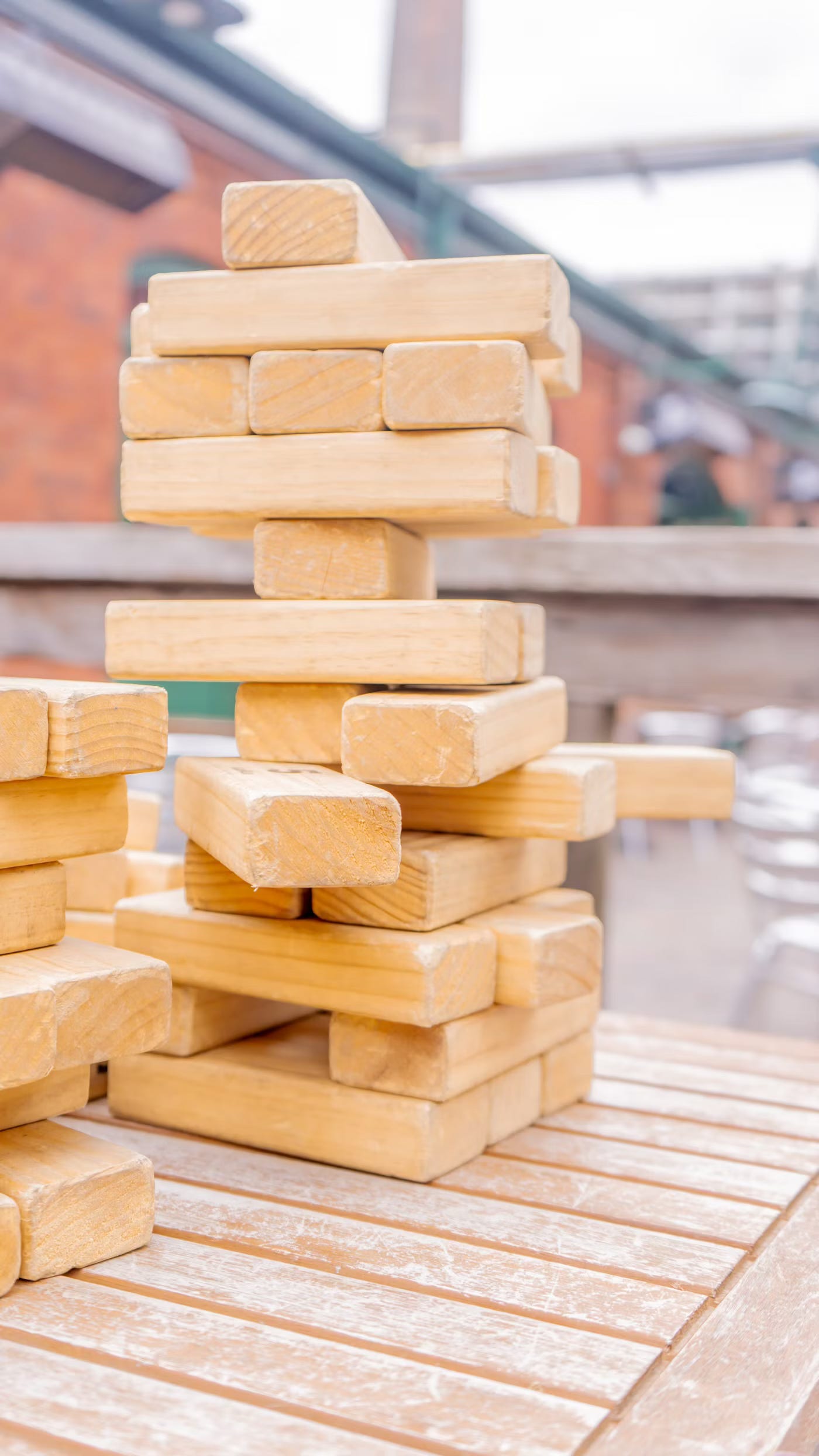
It's unusual that the Jenga structure, with its intrigue and demand for steady movement, popped into my consciousness three days ago.
Why, I wondered, and why now? I've not thought of nor played this game in years.
This prompted me to write, curious about what I would discover.
I first considered the global Jenga Tower—the tower of political and financial instability, the climate threat resulting from a serious disconnect between the human and the more-than-human world, and the collapse that happens when one piece after another is removed—whether calculatedly or erratically—from an already unsteady structure.
Had I had the opportunity to flesh out my thoughts yesterday, this post would be different.
But there was a night in between; a restless night of wildly colliding thoughts leading to more systematic processing of what is true now—on a small scale. For me personally.
While there are definite connections between the global Jenga Tower and how I experience it myself, that expansive iteration will need to wait for an opportune time.
For now, I take the Jenga Tower metaphor into today’s heart space, pulling it in for closer observation.
There have been numerous Jenga Towers throughout my life—some created for, around, or in spite of me; others that I’ve created more intentionally. It goes without saying that no framework within which we operate is ever solely a product of our own ingenuity. We may think it is, strategy consultants will insist that it can be, but it is not so. Every human being is interconnected broadly, whether consciously or not.
Some of the Towers of my life were built hastily, in a moment of immediate need and for a specific purpose. Like the time I dipped my toes into the stream of educational social services. More than a decade later, I realized how rich the lessons I learned had been; I had learned from people who were very different from me. But the removal of the grant-funding block of this particular Tower caused it to crumble into fragments.
The Jenga Tower of a religious establishment, which had been constructed over generations, permeated much of my early life. I did not conceive it, contribute to its construction, nor could I influence the shape it would take. In addition, how I fit into it this amorphous, imposing Tower seemed to have minimal, if any, impact on the Tower itself. The Tower, however, pushed and pulled, kneaded and filed my tiny Jenga piece into a shape I no longer recognized.
At the same time, the blocks of this unwieldy super-structure were being manipulated and shifted by forces which removed large, foundational chunks from the Tower, which ultimately ejected my tiny block in the process.
Those two examples are only a few of the Jenga Towers I’ve lived in: one relatively small, yet consequential; the other massive and resulting in overarching, fundamental changes to my understanding of life on this planet.
The Jenga Tower is a powerful metaphor to understand who we are, how we interact with life’s twists and turns, what each Tower contributes to or extracts from us, and how we navigate, even contribute to the building, destabilization, or collapse of the Tower.
No Tower of any era has survived, at least never in its entirety. Tower blocks may remain after a crash—possibly most of them, some of them willingly offering themselves for a rebuild.
Here's where we are called upon to take time to assess. Some of the Tower blocks, once functional, have become brittle from exposure to outside forces: hostile work environments, outdated organizational structures, ongoing interpersonal battles, or burnout. It’s our job to set aside the blocks that no longer serve to build a life-giving Tower.
Ironically, the building blocks that feel most steady and appear most desirable will stunt the growth of an organism that could be viable in the future. What has worked in the past will likely not work in the future.
But be aware: some of the blocks you’ll encounter will have unusual shapes—not the standard rectangular or square cubes we associate with a classic Jenga Tower. The blocks we’ll encounter for future builds will be asymmetrical, multi-compositional, and may seem counterintuitive as building materials and shapes. Our first reactions could be dismissive, being faced with what we do not know, followed by panic as we search for conventional building materials.
For example: Why would a deep connection with Nature be crucial for a robust, yet embracing spirituality? How can an understanding of the ancestors’ journeys empower humanity as it slides into collapsing modernity?
The blocks for tomorrow’s Jenga Towers, which must be built today, need to be resilient, yet fluid enough to sustain life in an era of great change, fluctuating extremes, and soul-crushing exhaustion.
The most recent Tower which I, along with my husband, have been called to dismantle is the Tower of a vibrant life in a chosen location, complete with its understood responsibilities, comforts, frustrations, challenges, and gifts. Not perfect, but life-giving; never fitting completely, but still offering fulfillment and grace.
Dismantling this Tower—that is, letting go of 95% of owned property, bidding tearful farewells to close friends and family, and submitting to uncertainty, has landed me in a place of picking up each block that once sustained this Tower, asking: is it suitable for the journey into the next era of human, interpersonal, transnational, and planetary survival?
I can now hear the call to pay attention to the radical shift in Tower building blocks: seeing the limbs, organs, and lifeblood of the new structure, instead of the certainty of rectangles and squares to fit into gaps of corresponding shapes. This may initially feel disconcerting, like questioning the stability of financial institutions or international corporations, for example.
I can now hear the call to pay attention to all that has been labeled unproductive: being still; reveling in a sunrise without haste; imagining my feet connected with the roots and microscopic fungal filaments of the trees around me; observing reverence for the elements of each meal—for the Earth’s willingness to keep giving generously despite our egregious abuses; pondering the back-breaking labor of those who bring each piece of my meal to the table.
So, we consider the Jenga Towers of the past and those who offer their service for the future.
Where have you experienced the systematic dismantling or crumbling of your Jenga Towers? I’d love to hear your thoughts about the changes that have dotted the landscapes of your life. The comment section is open for this.
📸 Emmanuel Olguin